Kayaking The Milwaukee River: Rentals, Launches, And Route Ideas
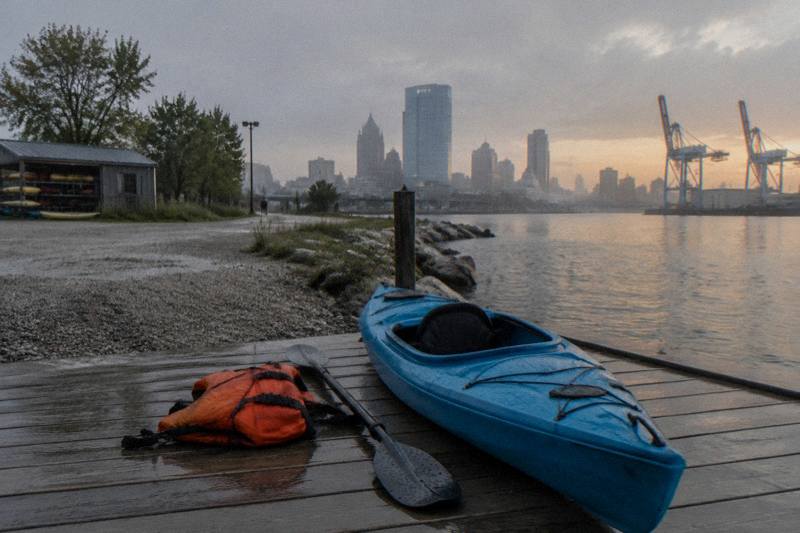
The Milwaukee River runs straight through downtown, under a stack of bascule bridges and past a Riverwalk lined with restaurants, and a kayak puts you on that water for less than the price of most cruises.
Short answer
Kayak rentals on the Milwaukee River start at from $55 for a four-hour single kayak and from $89.75 per tandem kayak from Brew City Kayak in the Harbor District, and a guided small-group skyline paddle runs from $83 per person. The paddling season runs roughly May to October, the Riverwalk lines both banks for 3.1 miles, and the bridges above you open on a federal schedule.
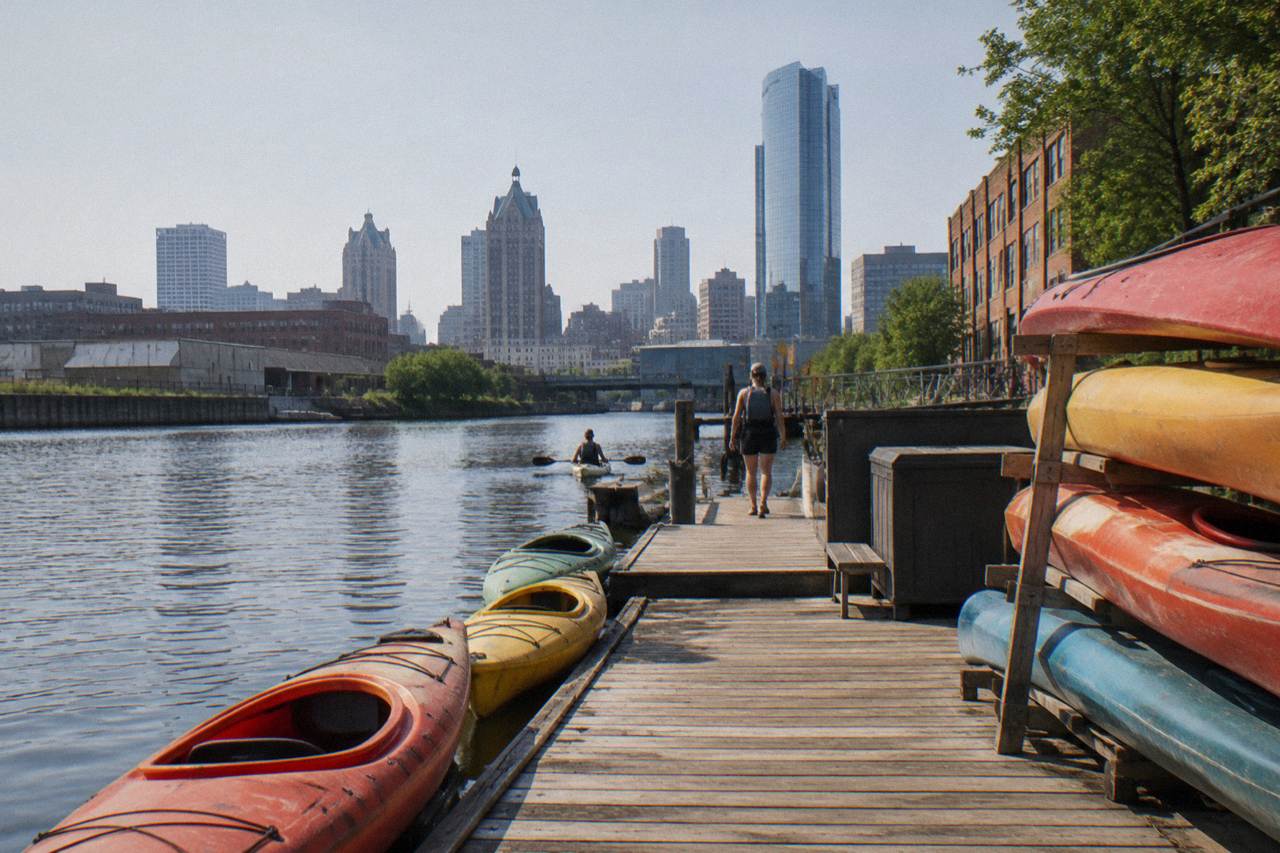
The Milwaukee River is one of the few urban waterways in the country where you can put a kayak in the middle of a downtown, paddle under a dozen movable bridges, and glide past restaurant patios close enough to hear the clink of glasses. The Riverwalk System runs 3.1 miles along both banks from the former North Avenue Dam site through downtown and the Historic Third Ward to Lake Michigan, and nearly all of it is reachable from the seat of a kayak. The Milwaukee River Boat Tours lineup leans into exactly this: a four-hour river kayak rental, a tandem option, a guided skyline paddle, a dock paddling session on the lakefront, and a private donut boat that cruises alongside the Riverwalk.
This guide covers the practical side of paddling the river: what rentals actually cost, where the public launches sit, how the bridges and boat traffic behave around small craft, and how a paddle stacks up against the narrated cruises that run the same water. Everything here comes from operator listings, the City of Milwaukee, and the federal bridge regulations that govern the river.
Where Can You Launch A Kayak On The Milwaukee River?
The main launch for the rental products on this site is Brew City Kayak at 820 S Water St in the Harbor District, south of downtown, while public launch and docking spots along the river include Pere Marquette Park on the west bank, the Riverfront Boat Launch at the end of Bruce Street near the Hoan Bridge, and Kiwanis Landing near the Humboldt Street bridge, plus several Riverwalk-adjacent docks downtown. Where you start shapes your whole paddle, because the river's character changes block by block from the quiet stretches upstream to the working harbor downstream.
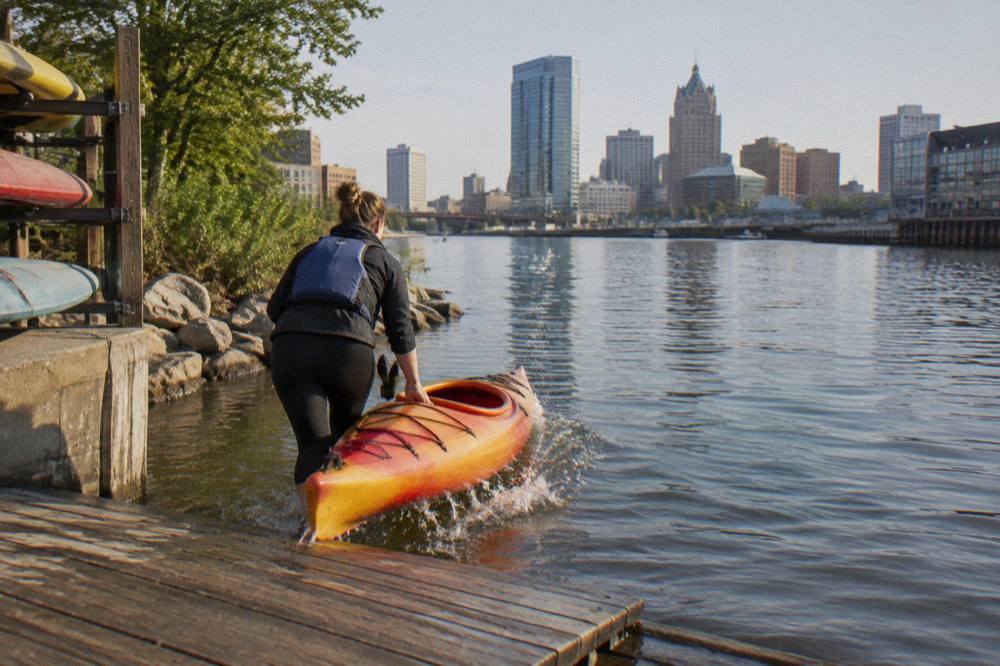
Brew City Kayak's Harbor District location at 820 S Water St puts you on the water south of the Third Ward, within easy reach of the inner harbor and, for stronger paddlers, the downtown canyon of bridges upstream. The listing for the Milwaukee River Kayak Rental includes the kayak, paddle, PFD (life jacket) and instruction, so a first-timer is not figuring out equipment alone at the dock. The meeting point matters for planning: there is no pickup or shuttle listed, so you walk, drive or rideshare to the dock.
Public access points give independent paddlers options. Milwaukee Kayak Company, a separate operator at 318 S Water Street at Jerry's Docks, also runs spots at the Schlitz Park Riverwalk and the Twisted Fisherman, and its guide to launching names Pere Marquette Park on the west bank, the Riverfront Boat Launch at the end of Bruce Street near the Hoan Bridge, Kiwanis Landing near the Humboldt Street bridge, and Riverwalk-adjacent docks near the Milwaukee Public Market and The TapYard. If you want the full downtown picture on foot as well as from the water, the Milwaukee Riverwalk guide walks the same 3.1 miles bank by bank.
| Launch spot | Where it sits | Best for |
|---|---|---|
| Brew City Kayak, 820 S Water St | Harbor District, south of the Third Ward | The rentals and guided skyline paddle on this site |
| Pere Marquette Park | West bank downtown, at State Street | Downtown bridge stretch, pontoon docks nearby |
| Riverfront Boat Launch, Bruce Street | Near the Hoan Bridge | Downstream paddle toward the harbor |
| Kiwanis Landing | Near the Humboldt Street bridge | Quieter upstream water, East Side approach |
| Jerry's Docks, 318 S Water St | Third Ward | Independent rentals from the other downtown shop |
| Dock at Discovery World, 500 N Harbor Dr | Lakefront harbor | The dock paddling session, flat protected water |
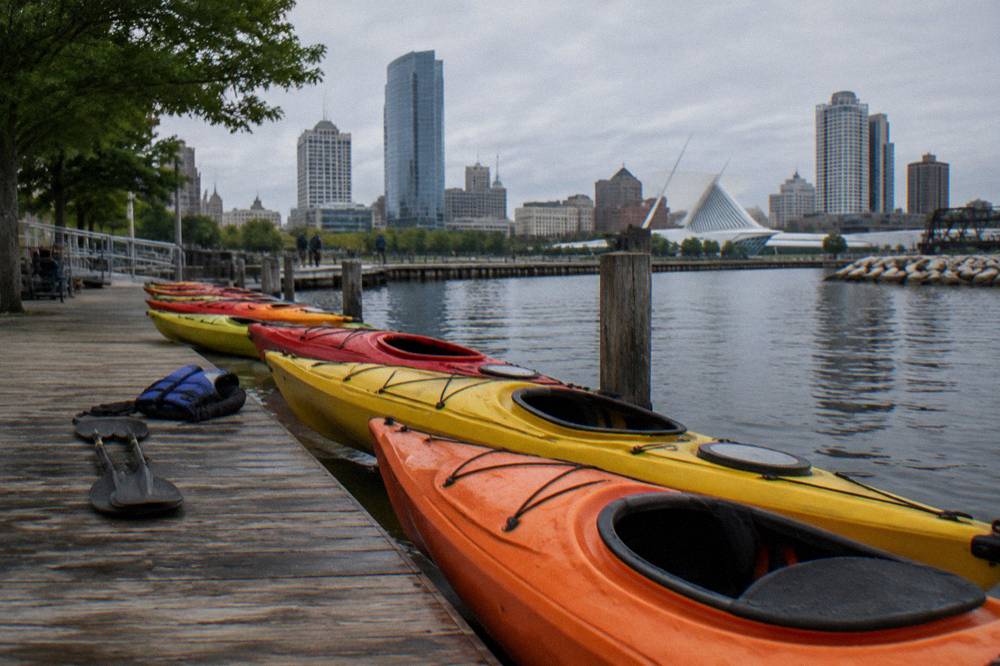
The Discovery World dock deserves a special mention for families and nervous first-timers. The dock paddling session there is a one-hour private session from $18 per person that stays at the dock on the lakefront harbor rather than committing to the river, and the listing includes a life jacket, a dry bag or floating phone case, sunscreen and a safety orientation. It is the gentlest entry point to paddling in Milwaukee, and the next available date sits in the summer season, so check the booking page when the season reopens.
How Much Does It Cost To Kayak The Milwaukee River?
A four-hour single kayak rental on the Milwaukee River runs from $55, a tandem runs from $89.75 per tandem kayak, the 90-minute guided skyline tour runs from $83 per person, and the one-hour Discovery World dock session runs from $18 per person. For comparison, the other downtown kayak shop lists single kayaks or paddleboards at $35 for up to 2 hours or $40 for up to 4 hours, with tandems at $65 and $75 for the same windows, so Milwaukee paddling sits in a narrow, competitive band either way.
The rental prices above are the operator's listing prices, not computed rates. What the listing does state plainly is what is included, kayak, paddle, PFD and instruction, and what is not: alcoholic drinks, food and drinks, and gratuity are excluded, with drinks available to purchase. Free cancellation is listed up to 24 hours before start, and a weather cancellation gives a new date or a full refund.
The four-hour window is generous for the downtown stretch. The river's runnable core from the Humboldt bridge area down through downtown to the harbor is a few miles of slow water, and four hours leaves time to drift, gawk at the architecture and stop for a snack without watching the clock. The river rental's description notes that breweries and restaurants line the river, which is the practical charm of this paddle: the takeout options are on the bank beside you, though food and drinks are not part of the rental itself.
| Product | Price as listed | Duration | What is included |
|---|---|---|---|
| Milwaukee River Kayak Rental | from $55 for the four-hour rental | 4 hours | Kayak, paddle, PFD, instruction |
| Tandem Kayak Rental | from $89.75 per tandem kayak | 4 hours | Kayak, paddle, PFD, instruction |
| Skyline Kayak Tour | from $83 per person | 1 hour 30 minutes | Guided small-group paddle, max 12, instruction |
| Discovery World Dock Paddling | from $18 per person | 1 hour | Life jacket, dry bag or phone case, sunscreen, safety orientation |
| Other shop, single kayak | $35 up to 2h, $40 up to 4h (operator lists) | 2 to 4 hours | Rental equipment from that operator |
If you are comparing against sitting on a boat instead, the narrated cruises are in the same price neighborhood: Milwaukee Boat Line lists its 90-minute narrated sightseeing tour at $28.99 adult and $14.49 child, and Edelweiss lists its Historic Narrated Boat Tour at $27.00 adult on weekdays, with a modestly higher weekend adult price the operator publishes on its own page. Those are operator prices, booked direct, and they buy narration and a deck rather than a paddle. The fuller price picture, including the brat and dinner cruises, is in the Milwaukee boat tour prices guide.
Should You Rent A Kayak Or Take A Guided Paddle Tour?
Rent if you want to set your own route and pace for four hours, and take the guided skyline kayak tour if you want a guide, instruction and a small group capped at 12 paddlers for 90 minutes at from $83 per person. The two products share an operator, Brew City Kayak LLC, and even a meeting point at 820 S Water St, so the choice is really about independence versus structure, not about location or quality.
The rental is self-guided by design. You get the equipment, a short orientation and four hours of river, and the listing supports up to 20 travellers per booking, which covers most friend groups and family pods. The tandem version, from $89.75 per tandem kayak, splits the work between two paddlers and suits couples or a parent with a child who is not ready to steer alone. Nothing about food, drinks or alcohol is included, and alcoholic drinks are excluded from the listing, though they are available to purchase where the operator offers them.
The skyline tour is the structured option. It runs an hour and a half, the group is capped at 12, and a guide leads the paddle with instruction included, which is the difference that matters for a first-timer who wants someone else watching the bridge traffic and the weather. It carries a 4.6 rating from 9 reviews on its listing, against the rental's 4.9 from 32 reviews, the most reviewed paddle in this lineup. Review pools that size are modest, so read a few reviews yourself rather than trusting the average alone.
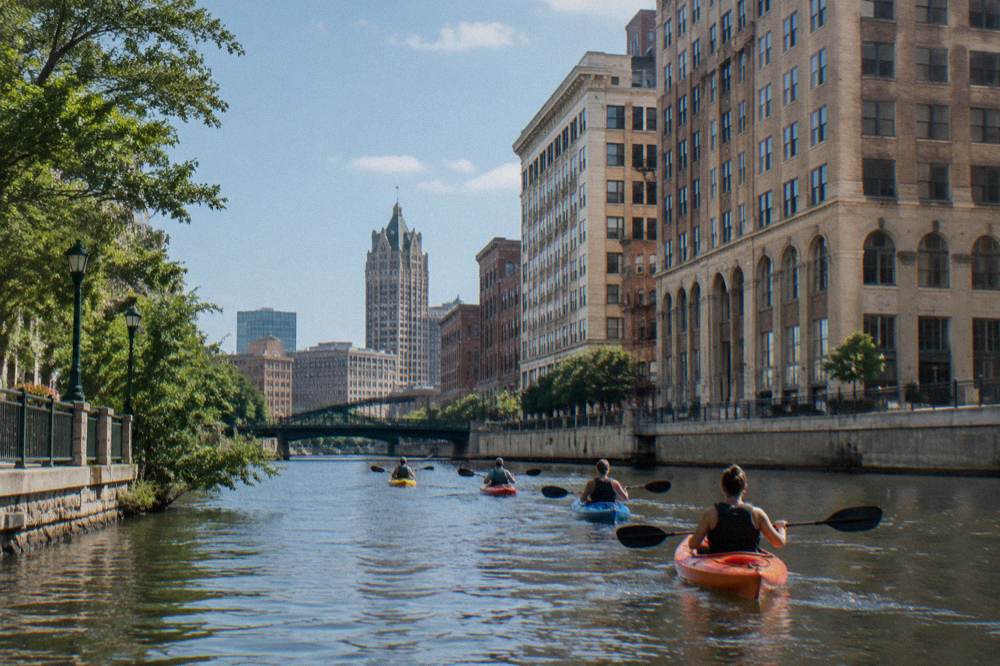
A reasonable rule of thumb: if your group contains confident swimmers who have sat in a kayak before, the rental gives you more river for the money. If anyone in the boat is nervous, new, or relying on someone else for navigation, the guide converts the river from a puzzle into a tour. Both cancel free up to 24 hours before start, and both rebook or refund fully when the operator cancels for weather.
Which Stretch Of The Milwaukee River Should You Paddle?
The classic downtown stretch runs from the Humboldt Street bridge area downstream through the Third Ward toward the harbor, passing under the bascule bridges of downtown with the Riverwalk and its restaurants on both banks, and it is the stretch the rentals and the guided skyline tour are built around. Upstream of downtown the water is quieter and greener; downstream of the Third Ward it opens toward the working harbor and the lakefront.
Paddling downstream from Kiwanis Landing near the Humboldt bridge gives you the mellow warm-up: residential banks, the occasional heron, and the East Side's bars and eateries drifting past before the skyline starts to stack up. As you approach downtown the character changes fast. The banks turn to condominiums and office towers, the Riverwalk appears at water level on both sides, and the first bascule bridges rise overhead. This is the postcard section, and it is why the skyline tour is named what it is: the guide leads you through the stretch where the skyline does the work.
The downtown bridge run demands a little more attention. Boat wakes from the river cruisers roll through, and the channel narrows between dock walls, so keep to the edges and let the bigger traffic pass in the middle. Below the Third Ward the river widens toward the inner harbor, and from there the lakefront and the Discovery World dock are close. Paddlers should treat the harbor mouth with respect: that is where the river meets Lake Michigan's commercial and recreational traffic, and conditions can change quickly. For a fuller sense of how the seasons change this water, the best time for a Milwaukee boat tour guide covers the same May-to-October window from the cruise side.
For families weighing which stretch suits kids, the honest answer is that the one-hour dock session at Discovery World beats both river options for small children, because it stays on flat, protected harbor water next to the museum. The river itself is slow and forgiving, but it is still a real river with real traffic, and the listings for the rentals do not state an age rule either way, so ask the operator before booking with young children. More family-side comparisons live in the Milwaukee boat tours with kids guide.
How Do The Bridges And Boat Traffic Treat Kayakers?
The drawbridges over the Milwaukee River operate under federal regulation, 33 CFR 117.1093, with key bridges like North Broadway, North Water and Michigan Street opening on signal except during weekday rush periods between April 16 and November 1, and many others requiring two hours advance notice, so kayakers should expect to pass under, not wait for, most bridges. A kayak paddles under a closed bascule bridge the way a rowboat does, through the fixed navigation spans, while the big cruisers are the vessels that need the deck to rise.
That single fact shapes river etiquette more than anything else. The narrated cruise boats, the Edelweiss fleet and the Milwaukee Boat Line vessels draw several feet and stand tall, so they hold the channel and wait on bridge openings. You do not. In practice this means a kayak can thread the whole downtown stretch without ever stopping for a bridge, while staying well clear of the boats that cannot. Give anchored and docking vessels a wide berth, cross the channel promptly rather than drifting across it, and remember that the tour boats run fixed schedules, so their captains are often working to a clock.
| Who moves | How | Why |
|---|---|---|
| Kayaks and canoes | Pass under closed bascule bridges through the navigation spans | Small craft fit beneath the fixed spans |
| Tour boats and cruisers | Wait for the bridge to open per the federal schedule | Their air draft and draft require a raised deck |
| Pontoon rentals | Pass under where clearance allows, open otherwise | Self-captained boats follow the same rules |
| Bridges | Open on signal or by advance notice per 33 CFR 117.1093 | Federal regulation governs downtown drawbridges |
The regulation itself is worth a skim if you are curious about the rush-hour carve-outs: the schedule is published as 33 CFR 117.1093, and it applies to the downtown river bridges during the navigational season from mid-April to the first of November. The city's own boating rules, which adopt Wisconsin state regulation, are covered in plain language in the rules for boating on the Milwaukee River post, including the slow-no-wake requirements that apply in the inner harbor. Paddlers are not exempt from those, and neither is anyone else.
One caution the listings back up: never treat any paddle as risk-free. The rental and tour listings include life jackets and instruction, and wearing the jacket rather than stowing it is the single best decision a downtown paddler makes, because boat wakes, bridge shadows and cold water all arrive without an appointment.

Is Kayaking Better Than A Boat Cruise For Seeing Downtown?
Kayaking wins on price per hour, closeness to the water and the freedom to stop, while the narrated cruises win on comfort, commentary and all-ages ease: a four-hour rental from $55 undercuts the $28.99 adult narrated cruise on duration but not on shelter, seating or a guide telling you what you are looking at. The honest framing is that they are different products that happen to share a river, and plenty of visitors do both on consecutive days.
The cruise fleet on this river is substantial. Milwaukee Boat Line runs 90-minute narrated tours on large double-decker vessels, the Vista King and the Voyageur, with live commentary, snacks and a bar, and dogs allowed on a leash, from its dock at 1124 N Martin Luther King Jr Drive; its experiences are listed at mkeboat.com. Edelweiss runs its Historic Narrated Boat Tour with volunteer narrators from Historic Milwaukee, Inc., passing the Milwaukee Art Museum, Discovery World and the Summerfest grounds from its dock at 205 W. Highland Ave, per edelweissboats.com. None of those are products this site sells; they book direct, and they are described here only as a fair comparison.
| Factor | Kayak rental | Narrated cruise |
|---|---|---|
| Listed price | from $55 for 4 hours, from $89.75 tandem | $28.99 adult, $14.49 child, operator lists |
| Duration | 4 hours | 90 minutes |
| Effort | You paddle | None |
| Commentary | None | Live narration on history and architecture |
| Weather exposure | Full | Deck or enclosed cabin |
| Food and drink | Excluded, available to purchase | Snacks and bar on board |
| Group size | Up to 20 travellers per booking | Large double-decker vessels |
| Cancellation | Free to 24h before, weather rebooks or refunds | Refund or reschedule if the captain cancels |
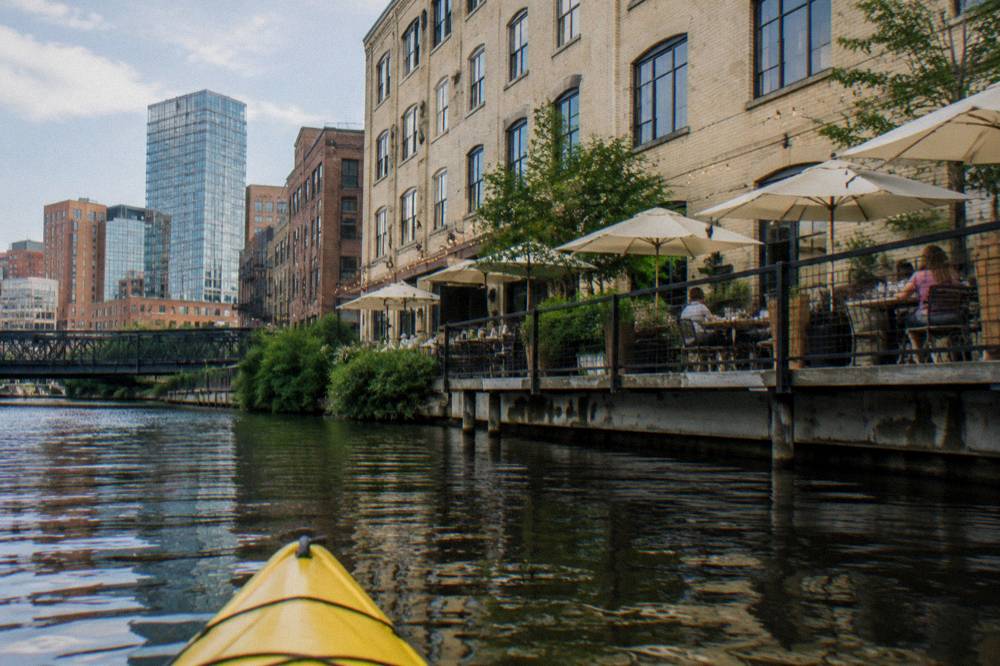
The vantage point is the real differentiator. From a kayak you sit inches above the water, eye level with the Riverwalk diners and the bridge footings, moving at a speed where the architecture unfolds detail by detail. From a cruise deck you see the skyline as a composition, with someone explaining which building is which. If your trip hinges on learning the city's history, ride. If it hinges on the sensation of being on the water in the middle of a city, paddle. The length question, what a river trip actually feels like hour to hour, is unpacked in how long a Milwaukee river cruise is.
What Should You Know Before You Paddle Downtown Milwaukee?
Plan around the season, dress for water temperature rather than air temperature, book ahead for weekends, and read the cancellation line on whichever product you choose: the paddling season runs roughly May to October, and every listing on this site shows free cancellation up to 24 hours before start with a new date or full refund on weather cancellations. The bookings currently show no open dates in October as the season winds down, and the platform reloads dates for the next season, so check the booking page for dates when the season reopens.
Timing within the season matters. Lake Michigan water temperatures run in the 44 to 54 degree range in May and climb into the 67 to 76 range by July, with mid-October readings near Milwaukee back down around 56 to 61 degrees, and those are approximate aggregator figures derived from NOAA data, not an official table. The river feels a touch warmer than the lake on most days, but the principle holds: an early-season paddle is a cold-water activity, so the included life jacket is worn, not sat on. Summer weekends put more boat traffic on the water but also more daylight and more Riverwalk life to paddle past.
What to bring is short and practical. The dock session at Discovery World is the only listing that names its extras outright, a dry bag or floating phone case and sunscreen, and those two items are exactly what a river rental wants too, along with a strap for glasses, water, and shoes that can get wet. The rental listing excludes food, drinks and alcoholic drinks, with drinks available to purchase, so plan any meal stop on the Riverwalk itself. If rain is in the forecast, the operators' own policies are more forgiving than you might expect, as covered in do Milwaukee boat tours run in the rain: Edelweiss does not cancel for rain, and the paddle products rebook or refund when weather cancels them.
Booking lead time is a real question on summer weekends, when the guided tour's 12-paddle cap and the rental fleet's finite boats both tighten up. The general guidance, book the water first and fill the weekend around it, is laid out in how far ahead to book a Milwaukee boat tour, and it applies doubly to small-craft products with hard caps. The dock session at Discovery World, with its next date shown in the following summer season, is the one to reserve early for a family slot.
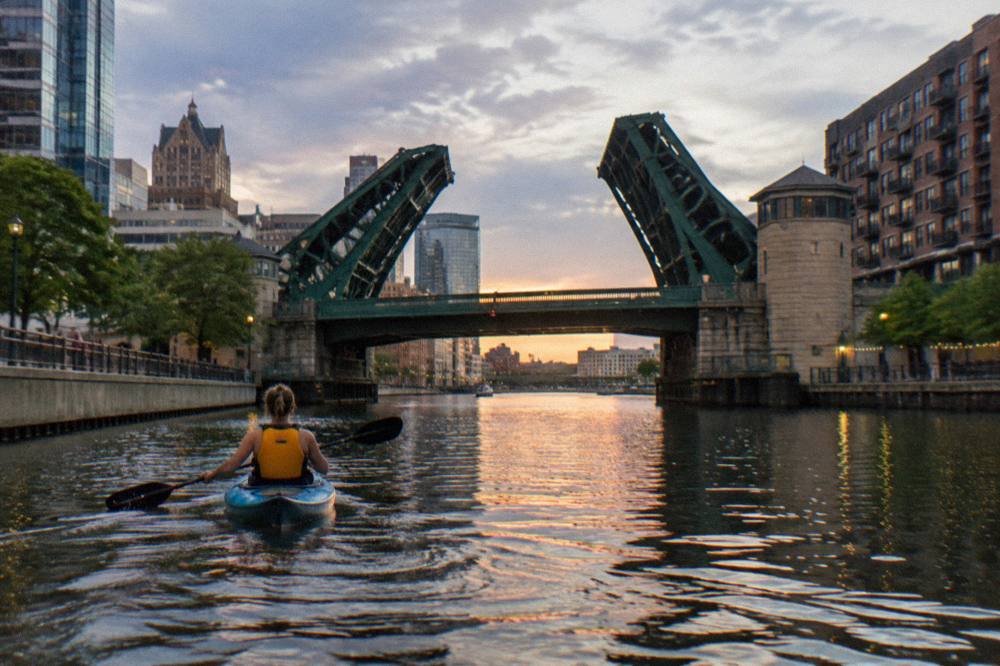
However you put a boat on this river, the essentials are stable: launch from the Harbor District or a public dock, paddle the downtown bridge stretch in the middle of the day or the golden hour, respect the cruisers that cannot maneuver the way you can, and be off the water before the evening chill arrives off the lake. The river does the rest. For pairing a paddle with everything else downtown offers, the things to do on the water in Milwaukee guide rounds out a full itinerary.
Common Questions About Kayaking The Milwaukee River
How much does it cost to kayak the Milwaukee River?
A four-hour single kayak rental runs from $55, a tandem runs from $89.75 per tandem kayak, the guided skyline tour runs from $83 per person, and the one-hour Discovery World dock session runs from $18 per person.
Where do you launch a kayak on the Milwaukee River?
The rentals and guided tour on this site launch from Brew City Kayak at 820 S Water St in the Harbor District. Public spots include Pere Marquette Park on the west bank, the Bruce Street Riverfront Boat Launch near the Hoan Bridge, and Kiwanis Landing near the Humboldt Street bridge.
Do the bridges open for kayaks?
Kayaks do not need the bridges to open; they pass beneath the closed bascule bridges through the navigation spans. The drawbridges operate under 33 CFR 117.1093, opening on signal for vessel traffic except during weekday rush periods between April 16 and November 1.
Is the Milwaukee River safe for beginner kayakers?
The downtown stretch is slow, protected water and the listings include life jackets and instruction, but no paddle is risk-free. The gentlest option is the one-hour dock paddling session at Discovery World, from $18 per person, which stays on flat harbor water next to the museum.
When is kayaking season on the Milwaukee River?
The paddling products run in the open-water season, roughly May to October. The listings currently show no open dates in October and reload dates for the next season, so check the booking page for dates when the season reopens.
Can you rent a tandem kayak on the Milwaukee River?
Yes. The tandem rental from Brew City Kayak runs four hours from $89.75 per tandem kayak and includes the kayak, paddles, life jackets and instruction. Food, drinks and alcoholic drinks are excluded, with drinks available to purchase.