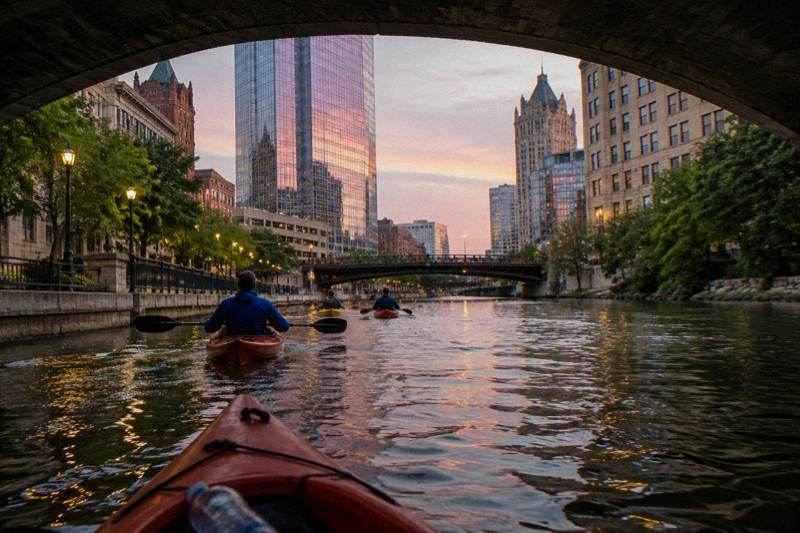
What Are The Rules For Boating On The Milwaukee River?
The boating rules that actually apply on the Milwaukee River: Wisconsin law, slow-no-wake zones in the inner harbor, drawbridge openings under 33 CFR 117.1093, right of way, and what renters need to know.
What Boating Rules Apply On The Milwaukee River?
The rules come from three stacked layers: Wisconsin boating law as adopted by city ordinance, slow-no-wake speed limits of about 5 mph in the inner harbor and near docks and piers, and the federal drawbridge regulation 33 CFR 117.1093 that sets when the downtown bridges open for boats. Renters follow the same rules as private owners, and every listing in this lineup includes life jackets and instruction. For most visitors the practical version is simple: keep speed down in the harbor, watch for bridge clearances, wear the life jacket the operator hands you, and know that the bridges mostly open on signal outside weekday rush periods between mid-April and the start of November.
The river is not a free-for-all, but it is also not intimidating. It is a working urban waterway about three miles through the downtown corridor as framed by the Milwaukee Riverwalk system, which the city describes as a 3.1-mile public walkway on both banks, open around the clock. Boats, tour vessels, pontoon rentals and kayaks all share the same channel, and the rules exist mostly to keep that sharing orderly.
Milwaukee's common council formally adopts Wisconsin's state boating statutes, chapter 30 of the Wisconsin Statutes and NR 5 of the administrative code, for city waters, per the city's chapter 118 ordinance. That means a paddler or renter on the Milwaukee River is operating under essentially the same legal framework as someone on any Wisconsin lake, with a few harbor-specific additions layered on top.
If you are renting rather than bringing your own boat, the operator carries part of the load. The river kayak rental, the tandem kayak rental and the guided skyline kayak tour from Brew City Kayak all include life jackets and instruction in the listing, and the private donut boat from Boat MKE is an electric vessel rented to your group for its 1 hour 45 minute run alongside the Riverwalk. The rules below still apply to you on the water.
Which Wisconsin Boating Laws Apply Downtown?
Wisconsin chapter 30 and NR 5 apply in full on city waters because Milwaukee's ordinances adopt them, covering registration, lighting, life jackets, negligent operation and age-free basics like riding properly in a moving boat. The state's slow-no-wake rule, generally within 100 feet of docks, piers and restricted areas, is the part downtown boaters feel most often, since the river is wall to wall with docks. Pontoon renters get an extra layer: Riverwalk Boat Tours & Rentals requires the renting driver to be at least 21 for its self-captained 21-foot boats.
Registration is the rule most private boaters ask about first. Any motorized vessel used on Wisconsin waters needs to be registered with the state, and numbering and lighting rules follow the standard state framework. If you are renting, this is the operator's problem, not yours. The rental company holds the registration and hands you a boat that already complies.
Life jackets are the rule that matters to everyone. Wisconsin law requires a wearable personal flotation device of the right size for each person on board, and children below a certain age must wear one while the boat is underway. Every paddling product in this lineup includes a PFD in the listing, and the guided skyline tour includes instruction on top of that, so a first-time paddler gets both the equipment and a walkthrough of how to use it.
Negligent operation is the catch-all. Circling close to another boat, wake damage near docks, and speeding through the moored-boat stretches downtown can all be written up under the negligent-operation language in state law. The Milwaukee River's downtown reach is narrow, lined with restaurants and docks, and the listing for the river kayak rental notes that breweries and restaurants line the banks, which is exactly why the slow-no-wake expectations bind so tightly here.
| Rule area | What applies on the Milwaukee River | Who it hits hardest |
|---|---|---|
| Registration and numbering | Wisconsin ch. 30 requirements for motorized vessels, adopted by city ordinance ch. 118 | Private boat owners, not renters |
| Life jackets | One wearable PFD per person, correct size; children must wear one underway | Everyone, including paddlers and rental groups |
| Slow-no-wake near structures | State rule within 100 feet of docks, piers and restricted areas | Pontoon renters and powerboaters downtown |
| Inner harbor speed | Slow-no-wake, about 5 mph, in the inner harbor per city-adopted state rules | Anything heading toward the lake |
| Negligent operation | General prohibition on careless operation endangering people or property | Wake-makers near moored boats |
| Rental age for self-captained pontoon | 21 or older to rent, up to 10 aboard including the driver | Pontoon rental groups |
One honest caveat: no official source identifies a blanket no-wake designation covering the entire Milwaukee River. What the sources do show is the inner harbor slow-no-wake requirement and the state's distance-based rules near docks and piers. Treat the downtown reach as wake-free by practice and by law near structures, and you will be right almost everywhere you actually paddle.
Where Does Slow-No-Wake Apply On The River And Harbor?
The clearest slow-no-wake zone is the inner harbor, where city-adopted state rules set the limit at about 5 mph, with additional state restrictions within 100 feet of docks, piers and restricted areas. The downtown river itself has no confirmed full-length no-wake designation in official sources, though the density of moored boats makes wake discipline the norm. In practice, kayaks barely produce a wake at all, which is one reason paddling products dominate the rental market downtown.
The distinction matters for pontoon renters. A 21-foot pontoon with 10 people aboard can throw a surprising wake at cruising speed, and the stretch between the Pere Marquette Park docks and the harbor passes moored boats, dockside diners and paddle traffic the whole way. The operator's rental agreement expects renters to know the harbor rules; the state framework is the reference, not the operator's brochure.
For paddlers the slow-no-wake question runs the other direction: wakes are something you receive, not something you make. The river kayak rental's four-hour window gives plenty of time to reach the downtown reach, and the sensible move is to take larger boat wakes bow-on rather than beam-on, the same advice any instruction session covers.
Electric vessels sit in a sweet spot. The private donut boat cruise is an electric motorized vessel for up to 10 passengers, cruising alongside the Riverwalk. Its listing includes a cooler, ice and a speaker, and the group rents the whole boat, which keeps the rule burden simple: the same state law applies, but the vessel's character makes most of it easy to satisfy.
Wondering whether a rental is the right way to put these rules into practice? Free cancellation is listed on every Brew City Kayak product up to 24 hours before start, and weather cancellations come with a new date or a full refund, so the commitment is low.
How Do The Downtown Drawbridges Open For Boats?
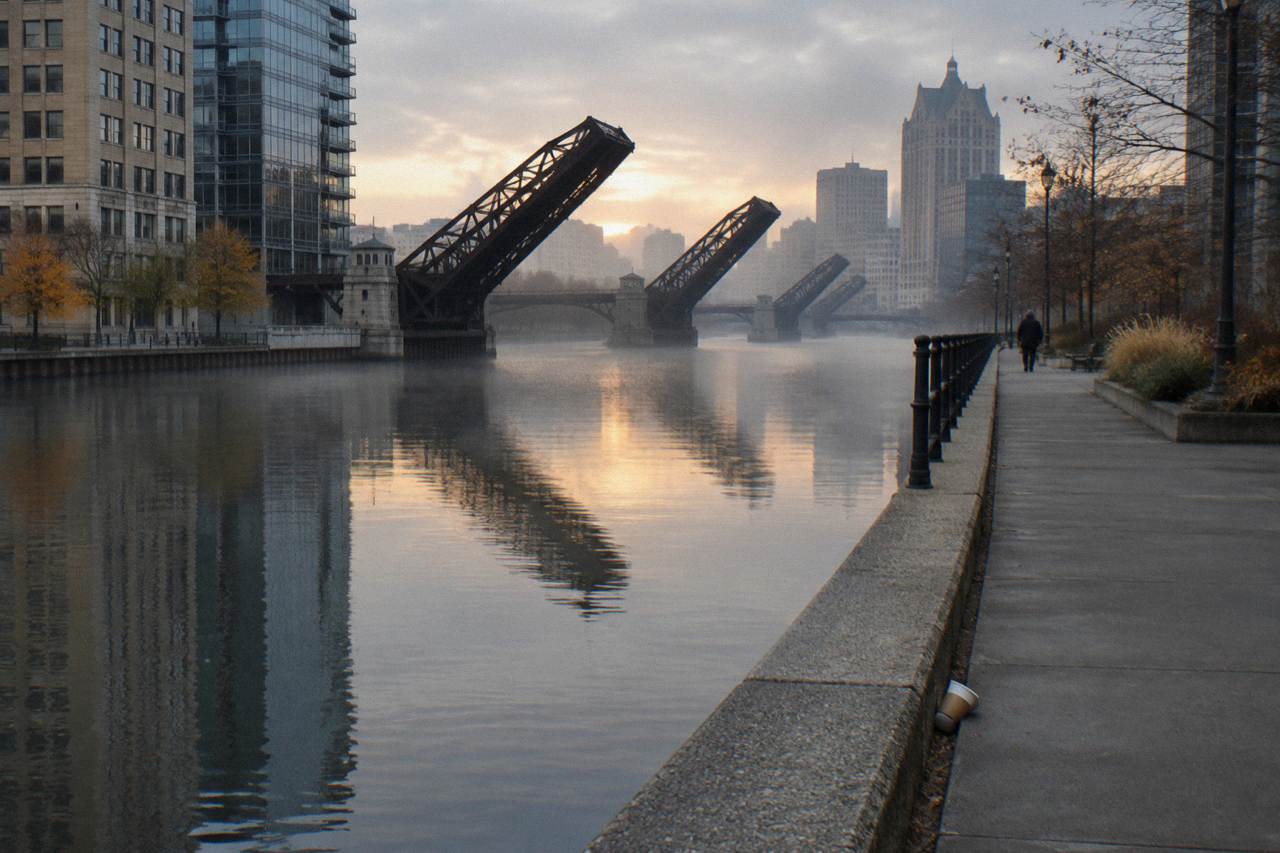
Drawbridge operation on the Milwaukee River is governed by the federal regulation 33 CFR 117.1093, under which bridges like North Broadway, North Water and Michigan Street open on signal for vessel traffic, except during weekday rush periods between April 16 and November 1, when many bridges instead require two hours of advance notice. A kayaker can generally pass under most bridges without an opening; taller powerboats and pontoon rentals must plan around the schedule.
The rush-period carve-out is the detail that surprises visitors. Boaters who arrive at a downtown bridge at 7:30 on a Tuesday morning may find it will not open for them on demand, because the federal schedule protects road traffic during peak commute windows in the open-water season. Outside those windows, and on weekends, the bridges open on signal: you hail or signal the tender, road traffic stops, and the leaf lifts.
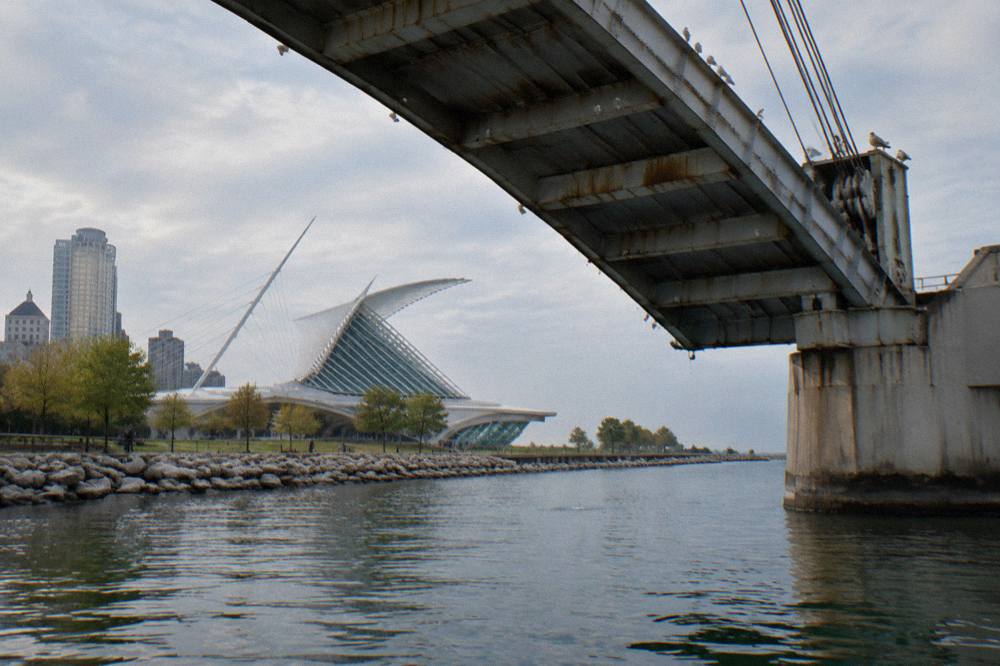
For the products in this lineup the question is mostly theoretical. Kayaks generally pass under the closed bridges on the downtown reach, so paddlers can keep moving through the heart of the river without waiting for an opening. Pontoon renters heading downriver toward the harbor are the group most likely to need a bridge opening, and the two-hour notice rule is the one to remember if the schedule says notice is required. The full text of the bridge schedule lives at the Cornell listing of 33 CFR 117.1093.
| Bridge situation | What the rule says | Practical effect |
|---|---|---|
| Weekday, outside rush, April 16 to Nov 1 | Open on signal for vessel traffic | Hail the tender and wait for the leaf |
| Weekday rush periods in season | Rush-period exceptions to on-demand opening | Plan around commute windows |
| Many other bridges or off-season requests | Two hours advance notice | Call ahead before you cast off |
| Kayaks and low electric boats | Pass under without an opening | No interaction needed |
| Taller rentals heading downriver | Opening required, schedule applies | Pontoon groups budget extra time |
One expired item is worth flagging so you do not plan around it: the Cherry Street bridge was closed to river traffic from November 1, 2025 to March 1, 2026 during its rehabilitation, and that closure window has passed. Check with the operator before booking a trip that passes a bridge under construction, since rehabilitation projects can repeat the pattern elsewhere.
Who Has Right Of Way On A Narrow Urban River?
Standard inland right-of-way rules apply: paddled vessels like kayaks generally have the stand-on status over powerboats, larger constrained-draft vessels keep to the channel, and everyone avoids the commercial tour boats that run fixed schedules through the downtown reach. On a river this narrow, the working custom is simple courtesy: keep right, pass wide, and never make a powerboat swerve in front of a bridge approach. The narrated tour boats run 90-minute loops from docks at 1124 N Martin Luther King Jr Drive and 205 W Highland Ave, and their captains know every foot of the channel.
Right of way on rivers has a river-specific wrinkle: the downstream vessel often has less maneuverability than it appears, and current, even a gentle one, changes stopping distances. A kayaker holding position mid-channel while deciding which direction to go is the classic hazard. The instruction included with every Brew City Kayak product covers the local conventions, which is a real advantage over showing up with your own boat cold. The rest of the planning pages sit on Milwaukee River Boat Tours.
Traffic density peaks on summer evenings and festival weekends, when the narrated boats, dinner cruises and rental fleets all share the water. The skyline kayak tour runs in small groups of no more than 12 with a guide out front, which is precisely the formation that stays predictable to other traffic. Self-guided renters should mimic the same discipline: travel as a loose line, not a scattered herd.
Festival periods deserve a note without dates: events at the lakefront festival grounds draw boat traffic toward the harbor, and the Air and Water Show weekends in late summer put anchored spectator boats on the lake rather than the river. The river itself stays open under the same rules; it just gets busier. The season for all of it runs roughly May to October, and the booking pages reload dates each spring.
What Do The Rules Mean For Kayaks Specifically?
Paddle craft follow the same state law as motorboats but with practical advantages: no registration requirement for the rental scenario, a PFD included in every listing in this lineup, no wake to manage, and the ability to pass under the downtown bridges without an opening. The main obligations are wearing the provided life jacket, keeping the group predictable in the channel, and staying off the water in conditions beyond your skill. No source on this site claims kayaking is risk-free; the point is that the rule burden is light.
The rental products make the legal side nearly invisible. The Milwaukee River Kayak Rental is a four-hour self-guided paddle from the Harbor District at 820 S Water Street, from $55 for the rental, and it carries a 4.9 rating from 32 reviews, the largest review pool in the lineup. The listing includes the kayak, paddle, PFD and instruction, and explicitly excludes food, drinks and gratuity. Alcohol is excluded too, though available to purchase, which lines up with the general wisdom that drinking and paddling mix poorly in both law and practice.
The tandem version, from $89.75 per tandem kayak for the same four hours, suits pairs who want one boat between them; it carries a 4.9 from 10 reviews. The difference between the two rentals is purely the boat: same operator, same dock, same inclusions. Neither is a guided product, so the navigation decisions, including when to turn around to make the four-hour window, belong to you.
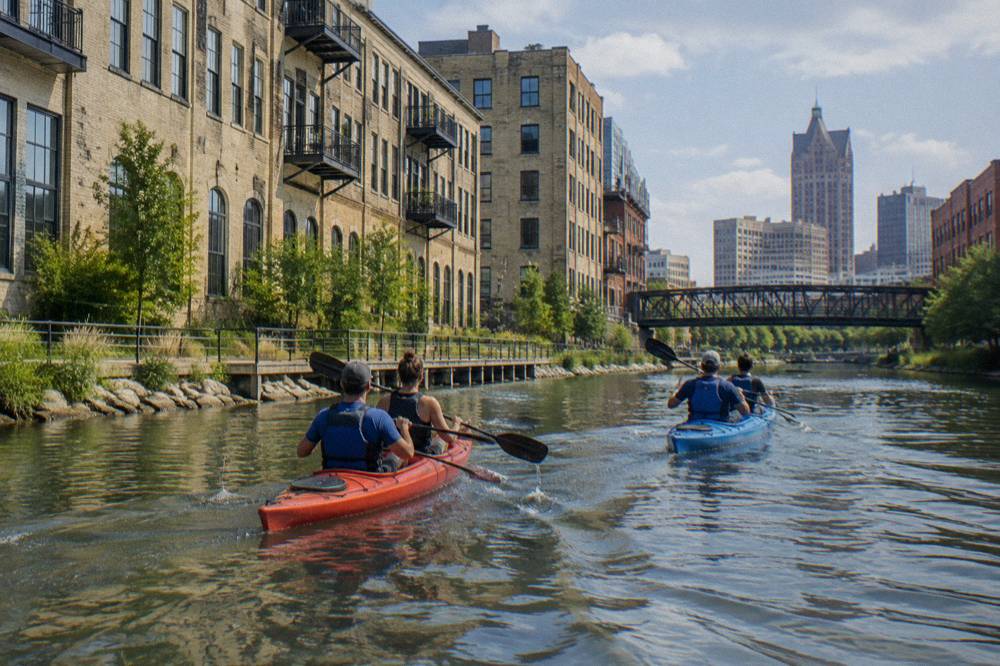
The guided skyline kayak tour, from $83 per person for 1 hour 30 minutes and rated 4.6 from 9 reviews, trades the four hours of freedom for a guide, a cap of 12 paddlers and built-in instruction. For a visitor who has never handled right of way, bridge traffic or the harbor current, that guide is the rules briefing made flesh. It meets at the same Brew City Kayak dock in the Harbor District.
Group size rules come from the listings, not from an invented regulation: the rentals accommodate up to 20 travellers across the booking, the skyline tour caps at 12, and the donut boat carries 10 passengers. No listed listing states an age minimum or weight limit, so ask the operator before booking if your group needs one confirmed; the listing does not say.
Where Can You Legally Launch And Dock?
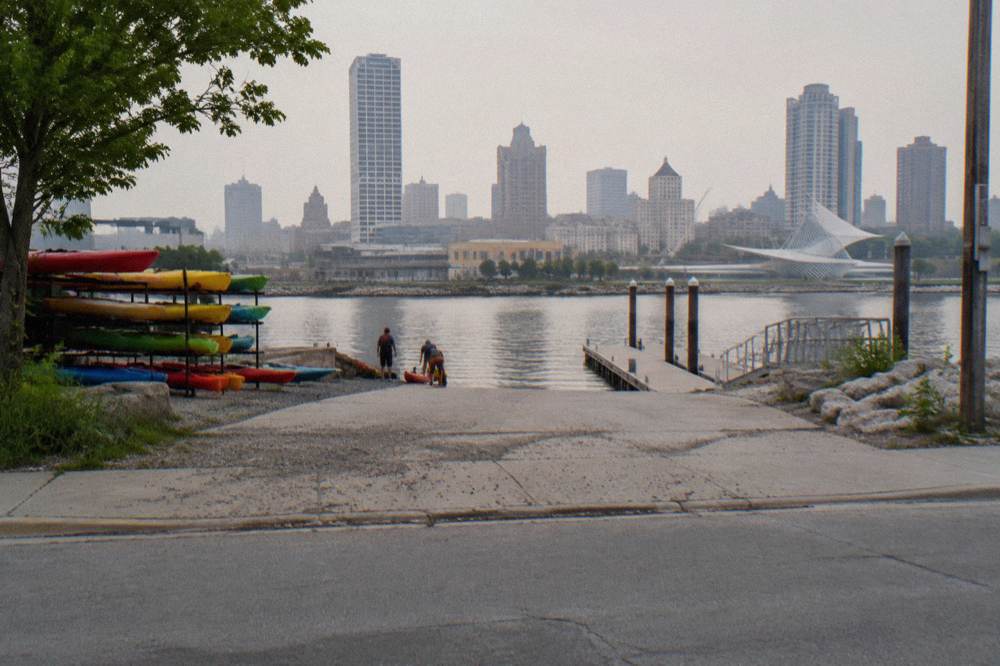
Public launch and docking spots on the Milwaukee River include Pere Marquette Park on the west bank, the Riverfront Boat Launch at the end of Bruce Street near the Hoan Bridge, Kiwanis Landing near the Humboldt Street bridge, and several Riverwalk-adjacent docks, according to a local operator's published guide to launches. The city's Riverwalk page, at city.milwaukee.gov/dcd/projects/riverwalk, documents the public walkway system itself, which is public and open 24 hours a day, 365 days a year.
Renters do not need any of this, strictly speaking, because the products launch from their own docks: Brew City Kayak's Harbor District base at 820 S Water Street, Boat MKE's docks at the end of Mason Street, and the Discovery World dock at 500 N Harbor Dr for the Forward Outdoor paddling session. The public launch list matters if you are combining a rental with your own boat, or scouting where to watch paddlers from shore.
| Access point | Location | Notes |
|---|---|---|
| Pere Marquette Park | West bank, State Street and N MLK Jr Drive | Also the pontoon rental docks |
| Riverfront Boat Launch | End of Bruce Street, near the Hoan Bridge | Closest to the harbor mouth |
| Kiwanis Landing | Near the Humboldt Street bridge | Upstream of downtown |
| Brew City Kayak dock | 820 S Water St, Harbor District | Launch for the rentals and skyline tour |
| Boat MKE docks | End of Mason Street, 104 E Mason St | Meeting point for the donut boat |
| Discovery World dock | 500 N Harbor Dr | Dock paddling session, lakefront harbor |
One seasonality rule trumps the rest: everything in this lineup runs in the open-water season, roughly May to October, and the booking pages currently show no open dates in October because the platform reloads dates for the next season. The Discovery World dock session lists its next available date in late June of the following year, which tells you how summer-specific the dock products are. In the off-season, the Riverwalk on foot is the water-level experience that stays open year-round; the Milwaukee Riverwalk guide covers it, and the rules of the river's bridges go deeper on the federal schedule.
What About Alcohol, Dogs And Weather Calls?
Alcohol is excluded from both kayak rental listings, available to purchase at the rental operation but not included, and no listed listing states a pet or accessibility policy beyond what it prints; where a listing is silent, ask the operator before booking. Weather cancellations across the lineup come with a new date or a full refund, and free cancellation is listed up to 24 hours before start on every product. Those operator policies sit on top of the law, not instead of it.
On the commercial cruise side of the river, the policies are published and specific: leashed dogs are allowed on Milwaukee Boat Line narrated cruises with a limit of five per sailing, Edelweiss accommodates manual wheelchairs with a call ahead but not motorized ones, and Edelweiss bars went cashless from the 2026 season. Those facts apply to those operators' vessels, not to the rentals on this site. For the paddling and donut boat options, the honest answer to most amenity questions is simple: the listing does not say, so ask the operator before you book.
The weather call on a river is different from the lake. Edelweiss runs in rain and cancels only for severe weather under Coast Guard advisories, and Milwaukee Boat Line leaves the call to the captain. For paddlers, rain is uncomfortable but wind is the real decision, since the downtown reach funnels it. The rain policy question gets its own treatment elsewhere; the short version here is that the lineup's cancellation terms are generous enough that a weather call is not a financial gamble.
The rules picture, assembled: state law adopted by the city, a slow-no-wake inner harbor, bridge openings on a federal schedule, ordinary right of way, and operator policies covering the gaps the law does not reach. A renter who reads the instruction briefing, wears the PFD and keeps the speed down near docks has covered nearly all of it.
Common Questions About Milwaukee River Boating Rules
What Are The Rules For Boating On The Milwaukee River?
Wisconsin boating law as adopted by Milwaukee ordinance applies, including life jacket requirements and slow-no-wake rules near docks and in the inner harbor at about 5 mph, and the downtown drawbridges open under the federal schedule in 33 CFR 117.1093, generally on signal outside weekday rush periods between April 16 and November 1. Renters follow the same rules, and the listings in this lineup include life jackets and instruction.
Do kayaks have to follow the same rules as motorboats?
Yes, the same state framework applies to paddle craft, with the practical difference that kayaks make no wake and can pass under most downtown bridges without an opening. Every paddling product in this lineup includes a PFD and instruction in the listing.
Is the whole Milwaukee River a no-wake zone?
No official source confirms a blanket no-wake designation for the entire river. What is confirmed is slow-no-wake, about 5 mph, in the inner harbor, plus the state rule within 100 feet of docks, piers and restricted areas, which covers most of the downtown reach in practice.
Do the bridges open on demand?
Under 33 CFR 117.1093, bridges including North Broadway, North Water and Michigan Street open on signal except during weekday rush periods from April 16 to November 1, and many other bridges require two hours advance notice. Low vessels such as kayaks pass under without an opening.
Can I drink alcohol on a kayak rental?
Alcoholic drinks are listed as excluded from both kayak rentals, though available to purchase, and food and drinks are not included. Beyond the listing, mixing alcohol and paddling is a poor match under any reading of the negligent-operation rules.
When does the boating season run?
The products in this lineup run in the open-water season, roughly May to October. The booking pages show no open dates in October and reload dates for the next season, so check the booking page for dates when the season reopens.